


Guide to High Performance Professional Volleyball Price and Quality
Securing high-performance athletic equipment requires a precise balance between material specifications and budget allocation. For procurement managers and sports distributors, understanding the variables that dictate the professional volleyball price is essential for maintaining a competitive edge while ensuring athlete safety and game consistency. The quality of a ball's construction—from the outer synthetic leather to the internal bladder—directly impacts its aerodynamic stability and responsiveness on the court.
At Hebei Starry Sports Goods Co, Ltd, we integrate advanced production techniques with rigorous material selection to deliver equipment that meets international standards. Whether you are sourcing for professional leagues, youth academies, or commercial retail, the choice of PVC, PU, or TPU materials defines the durability and touch of the product. This guide examines the technical architecture of professional-grade balls and how manufacturing efficiencies translate into value for the end buyer.

Technical Construction and Material Science in High-Performance Ball Manufacturing
The performance of a professional sports ball is rooted in its material composition. Most high-end balls utilize PU (Polyurethane) or TPU (Thermoplastic Polyurethane) for the outer shell, as these materials provide a superior grip and consistent bounce compared to standard PVC. The molecular structure of PU allows for better impact absorption, reducing the risk of injury during high-velocity spikes and serves, while ensuring the ball maintains its spherical integrity over thousands of repetitions.
Beyond the surface, the internal construction is equally critical. The use of high-quality bladders ensures air retention and prevents deformation. Machine-sewed construction, as implemented in our Size 5 models, provides a uniform seam height, which is vital for predictable flight paths. When buyers analyze the professional volleyball price, they are essentially paying for the precision of these seams and the grade of the synthetic leather used to wrap the core.
- PU Shells: Offer a soft touch and high elasticity for professional match play.
- TPU Integration: Enhances durability and water resistance for diverse environments.
- Machine Stitching: Ensures structural symmetry and consistent aerodynamic performance.

Operational Application Scenarios and Performance Requirements
Different sporting environments demand different technical specifications. For professional match play, a ball must exhibit a perfectly balanced weight and a low coefficient of friction to allow for precise control. In contrast, training balls for youth academies prioritize abrasion resistance to withstand the rigors of daily, high-volume use on various court surfaces, including hardwood and synthetic polymers.
The Size 5 standard is engineered for players aged 12 and up, providing the necessary weight for powerful shots and accurate passing. For distributors, offering a tiered range—from TPU-coated training balls to premium PU match balls—allows them to meet the needs of different market segments. The application logic is simple: the higher the intensity of the game and the higher the requirement for precision, the more specialized the material needs to be.
Procurement Strategy: Evaluating Supplier Capabilities and Quality Control
When sourcing from a manufacturer, procurement managers should look beyond the initial quote and evaluate the production infrastructure. A facility that covers a significant area, such as our 67,000 square meter plant, typically possesses the scale to maintain consistency across large batches. This scale reduces the variance in weight and circumference, which is a common failure point in lower-tier manufacturing.
Quality control should focus on the "details of success." This includes testing the air pressure retention of the bladders and the tensile strength of the stitching. An experienced supplier will provide customization options—such as custom logos and colors—without compromising the structural integrity of the ball. By partnering with a manufacturer that has a global export footprint in Asia, Europe, and South America, buyers can be assured that the products meet a variety of international regulatory standards.
Comparison of Material Specifications and Suitability
| Material Type | Touch & Feel | Durability Level | Primary Application |
|---|---|---|---|
| Premium PU | Soft / High Grip | Medium-High | Professional Matches |
| Reinforced TPU | Firm / Consistent | High | Intensive Training |
| Standard PVC | Hard / Smooth | Medium | Recreational Play |
| TPVC Hybrid | Balanced | High | School Programs |
| Custom Synthetic | Variable | Application-dependent | Promotional Events |
Manufacturing Efficiency and the Value Chain in Sports Equipment
The cost of a professional sports ball is influenced by the vertical integration of the manufacturer. By controlling the process from raw material selection to final packaging, companies can eliminate unnecessary middle-man markups. Hebei Starry Sports Goods Co, Ltd focuses on "excellent quality and reasonable price," leveraging a professional management team and advanced production technology to optimize the output of over 5 million balls annually.
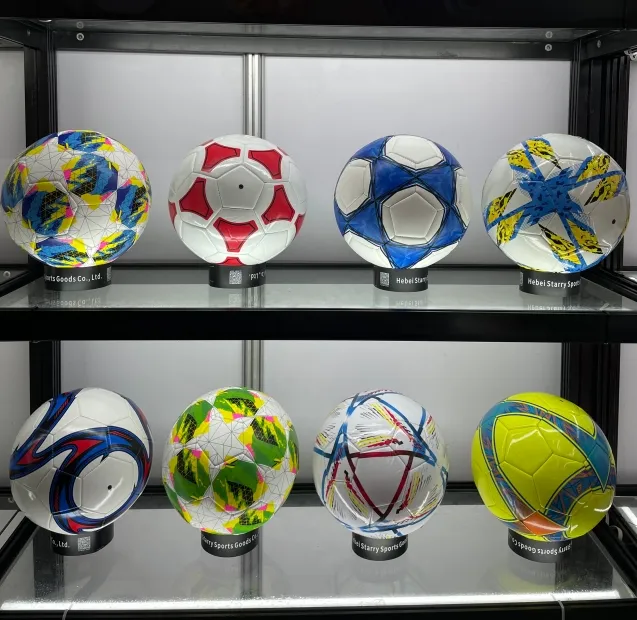
Innovation in color matching and appearance also adds commercial value. In a crowded retail market, the visual appeal of a product—driven by rich color palettes and modern designs—can be a deciding factor for consumers. However, the true value lies in the internal quality; the ability to maintain a strict circumference (such as the 218mm standard for Size 5) and weight (400-420g) ensures that the product is not just a commodity, but a professional tool for athletes.
Future Trends in Sports Ball Technology and Sustainable Sourcing
The industry is moving toward more sustainable materials without sacrificing performance. The research and development of eco-friendly TPU and recyclable bladders are becoming priorities for global brands. As sustainability becomes a key metric for procurement managers in Europe and North America, manufacturers who invest in green production techniques will likely dominate the future market.
Furthermore, the integration of smarter manufacturing—using automated precision stitching and AI-driven quality inspection—is reducing defect rates. For the buyer, this means greater consistency in every shipment. The trend is clear: the future of sports equipment lies in the intersection of high-performance engineering, sustainable materials, and scalable manufacturing precision.
Frequently Asked Questions About Professional Ball Procurement
What is the difference between PU and PVC balls for professional use?
PU (Polyurethane) provides a softer touch, better elasticity, and superior grip, making it the standard for professional matches. PVC is more rigid and is typically used for recreational or low-cost training balls due to its lower cost and different tactile properties.
How does the Size 5 specification affect gameplay?
Size 5 is the global standard for adult and youth leagues (12+). Its specific circumference and weight are engineered to provide a balanced flight path and predictable bounce, which is essential for executing professional-level shots and passes.
Can we customize the logo and colors for bulk orders?
Yes, we provide full customization services, including customer logos and specific color matching, ensuring that the branding is integrated without affecting the ball's aerodynamic performance or material quality.
What factors most influence the wholesale cost of these products?
The primary drivers are the grade of the outer material (PU vs TPU vs PVC), the stitching technique (machine vs hand), the order volume, and any specific customization requirements requested by the client.
How is the durability of machine-sewed balls ensured?
Durability is ensured through the use of high-tensile synthetic threads and precise seam alignment, which prevents the panels from separating under the high pressure and impact of professional play.
What should I look for in a reliable sports ball manufacturer?
Look for manufacturers with significant production capacity, a proven export history to diverse global markets, and a commitment to using certified raw materials to ensure consistency across batches.
Technical References and Industry Standards
- FIVB Official Equipment Standards
- ISO Quality Management Systems for Manufacturing
- Global Athletic Equipment Specifications
- Sport Engineering Material Analysis
Choosing the right professional equipment is a strategic decision that impacts athlete performance and brand reputation. By focusing on material science and manufacturing precision, you can ensure your investment delivers long-term value on the court.
Related Industry Insights





 English